 This is an official GOUV website. How do I know?

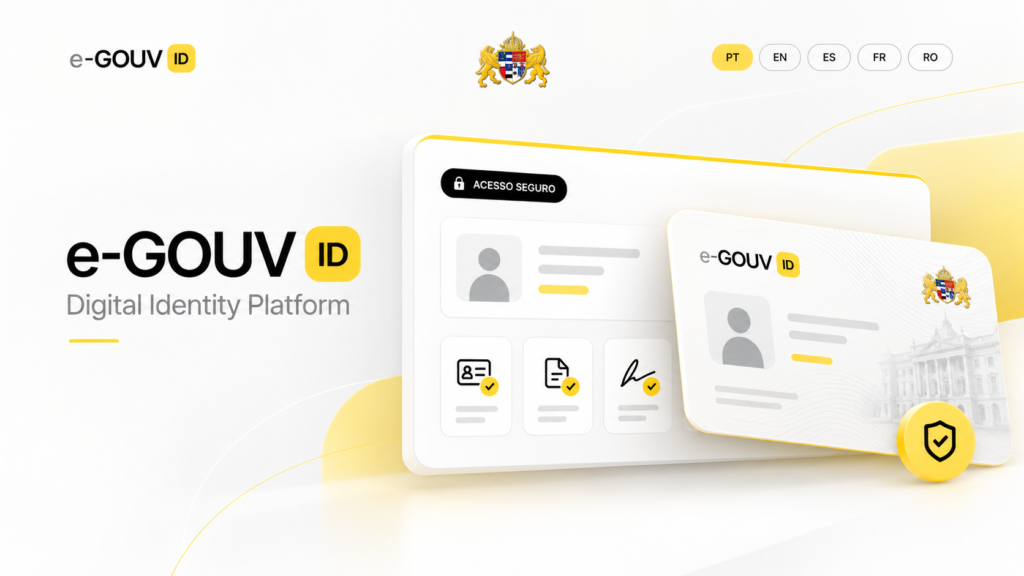
GOUV is taking a new step in its digital transformation with the launch of e-GOUV ID, the organization’s institutional platform for digital identity, authentication, electronic signatures, and document verification.
Available at id.gouv.services, the portal was developed to bring different categories of users within the GOUV ecosystem into a single digital environment — from foreign citizens and e-Residents to GOUV citizens, foreign diplomats, and members of the GOUV Diplomatic Corps.
More than an access account, e-GOUV ID operates as a digital identity and institutional trust infrastructure, allowing individuals to be identified, documents to be registered, digital signatures to be executed, credentials to be validated, and a verifiable relationship to be established between a user and GOUV services.
A Digital Identity for Different User Profiles
e-GOUV ID was designed on the principle that different people maintain different types of relationships with GOUV.
For this reason, the system organizes users into specific categories, each associated with a distinct institutional status and visually identified within the portal.
Foreign Citizen
The Foreign Citizen category serves as the entry point for individuals who have an identity registered within the GOUV ecosystem but do not hold GOUV e-Residency or GOUV citizenship.
This category is visually identified in silver.
Users may maintain their digital profile, personal data, nationality, identification documents, and other information required for services provided by the organization.
The system uses the category prefix X within the GOUV ID structure assigned to foreign users.
Holding an e-GOUV ID under this category does not mean holding GOUV citizenship or e-Residency. Its purpose is to establish a verifiable digital identity for services compatible with that profile.
e-Resident
The e-Resident category, visually identified in yellow, represents users who have been granted digital residency status within the GOUV ecosystem.
e-Residents hold a digital identity linked to their institutional status and may access services specifically made available to this category.
GOUV IDs issued to e-Residents use the category E within the identification structure.
The e-Residency process may involve review of documentation, personal information, nationality, declared languages, and, where applicable, supporting documents accompanied by their respective translations.
GOUV e-Residency is a distinct digital status within GOUV and should be understood within the organization’s own institutional and service framework.
GOUV Citizen
Users recognized as GOUV Citizens belong to the organization’s citizenship category.
Their profile is visually identified in black, while the GOUV ID structure uses the classification C.
A citizen profile establishes a broader institutional relationship with GOUV and represents one of the central categories of the e-GOUV infrastructure.
The profile may integrate information related to the citizen’s identity, documentation, GOUV ID history, institutional links, and services made available according to their status.
Where applicable, the digital identity may also serve as an interoperability layer with other GOUV systems and institutional documents.
Foreign Diplomat
e-GOUV ID also includes a specific category for Foreign Diplomats recognized or registered within GOUV’s institutional environment.
These profiles are visually identified in blue.
The system distinguishes the individual’s nationality from their diplomatic role. This allows the profile to display the flag of the person’s country of origin or representation without confusing nationality with institutional function.
Where a representative is linked to the United Nations, the appropriate identification may also be displayed according to the information registered in the profile.
GOUV Diplomatic Corps
Members of the GOUV Diplomatic Corps form a separate institutional category, visually identified in red.
The profile may contain information relating to the person’s function, position, department, institutional title, and relationship with GOUV.
The visual classification makes it possible to immediately distinguish a member of the GOUV Diplomatic Corps from a foreign diplomat registered in the system.
A Unique and Verifiable GOUV ID
Each eligible identity may receive a GOUV ID, a digital identifier used to distinguish the user within the system.
The format follows a standardized institutional structure, such as:
XX00.A0100.N00000-01
The identifier can be used by the portal itself to confirm the identity and its status.
e-GOUV ID also maintains a history of identifiers, which is important for preserving continuity when a user changes category, updates their registration, or undergoes other administrative changes.
A historical GOUV ID does not automatically replace the user’s current primary identifier. The platform distinguishes the active record from identifiers previously associated with the account.
Internal audit mechanisms also make it possible to detect inconsistencies, prevent duplication, and preserve identifiers already considered compliant.
Public Identity Validation
One of the platform’s key features is that third parties do not necessarily need a GOUV account to verify certain information.
The public area of the portal provides a Validate GOUV ID function.
By entering the relevant identifier, third parties can confirm the status of the digital identity according to the information made available by the system.
This creates an additional layer of trust for organizations, departments, partners, and other parties receiving GOUV-related documents or credentials.
Digital Documents Within e-GOUV ID
The portal was also designed to function as an environment for managing documents linked to a user’s identity.
Depending on the category and applicable permissions, registered documents may include information such as:
- issuing country;
- document type;
- number or reference;
- relationship to the identity holder;
- corresponding digital files;
- administrative status of the record.
Private documents remain linked to the authenticated environment and to the applicable access rules.
The platform also retains audit mechanisms for certain operations performed on these records.
A New System for Verifying GOUV Documents
e-GOUV ID introduces a dedicated mechanism for confirming the institutional origin of documents issued and registered by GOUV.
New documents may contain two complementary identifiers:
Document Number
and
Registration Number
To perform a public verification, both codes must be entered exactly as they appear on the document.
This architecture avoids relying on a single reference number and makes it possible to connect the document presented by a third party to the corresponding institutional record.
The verification may display different administrative statuses, including documents that are active, suspended, revoked, cancelled, or expired, where applicable.
Comparing a PDF With the Institutional Record
Document verification can go beyond the identifiers printed on the document.
Where available, the person performing the verification may upload the PDF file itself for comparison with the digital record stored by GOUV.
The system uses file-integrity mechanisms to determine whether the submitted PDF corresponds to the file associated with the institutional record.
This functionality is particularly relevant where a third party receives a digital document and wishes to verify not only its reference numbers, but also whether the file corresponds to the one registered by GOUV.
The verification confirms the origin and integrity recorded within the GOUV system. It does not replace procedures such as an Apostille under the Hague Convention, consular legalization, or other formalities that may be required under national law.
Historical Registration of Earlier Documents
The implementation of the new document registry also preserves GOUV documents issued before the current system was introduced.
Documents issued before 4 September 2026 are included in the historical registry and may be verified using their original document number together with the historical registration code:
LEG-040926
Documents registered after the implementation of the new system receive their own individual registration numbers.
This ensures that the technological modernization does not eliminate the possibility of verifying documents issued under the previous framework.
GOUV Electronic Signatures
Another central component of e-GOUV ID is its electronic signature infrastructure.
Authorized users may sign PDF files using their identity registered within the system.
The procedure may include confirmation through a code sent to the email address associated with the account, creating an additional authentication step before the signature is finalized.
The signature embedded in the document may include elements such as:
signatory name;
GOUV ID;
date of signature;
verification key or reference.
The document therefore carries information that can connect a specific signature to the identity used at the time the operation was completed.
Signature Verification Without Login
The authenticity of a GOUV signature may also be verified publicly.
The portal provides an option to verify a signature without logging into an account, allowing third parties to validate signed documents they have received.
This principle is essential to a trust infrastructure: the recipient of a document does not need to belong to GOUV in order to verify the signature presented.
Documents With Multiple Signatures
The system has also been developed for documents requiring the participation of several individuals.
Contracts, agreements, institutional instruments, and other documents may contain multiple GOUV signatures.
In these cases, the portal preserves existing signatures as additional signatories participate in the document.
The system also distinguishes between two important concepts:
signature validity and overall file integrity.
For example, a document may legitimately receive an additional signature at a later stage. This technically modifies the original file, but does not necessarily mean that the previous signatures must be considered invalid.
The platform can therefore recognize existing GOUV signatures while also displaying an alert where a subsequent modification of the file is detected.
This architecture was designed in particular for institutional documents signed sequentially by multiple officials.
Identity, Nationality, and Flags
The visual representation of identity was also taken into account during the development of the portal.
The system uses the information recorded in the user’s profile to display the flag corresponding to the person’s nationality or representation.
For countries belonging to the European Union, national identification may be displayed alongside the corresponding European reference.
Diplomatic profiles linked to the United Nations may use the appropriate UN identification where this information is registered.
GOUV institutional identity, in turn, is displayed according to the user’s relationship with the organization and does not automatically replace the individual’s declared nationality.
This distinction is particularly important in an international platform, where nationality, digital residency, and institutional role are separate concepts.
Identity Verification and KYC
The platform has been designed to support identity-verification processes across different devices.
Among the mechanisms planned or supported are document-reading technologies and NFC, particularly on mobile devices capable of performing this type of authentication.
Where automated verification cannot be used, the process may rely on alternative procedures, including manual review and, where necessary, complementary identification measures.
The objective is to provide additional levels of assurance for services that cannot rely solely on information declared by the user.
An International Digital Profile
e-GOUV ID was built for an international organization and therefore supports a broad structure of internationally recognized countries and territories.
Fields such as nationality, residence, and issuing country of documents use standardized country data, codes, and flags.
This allows foreign users to be registered consistently regardless of their country of origin.
Institutional Relationship With GOUV
The system also distinguishes users who hold a direct functional or institutional relationship with GOUV from those who access services solely as external users.
Where a GOUV relationship exists, the profile may contain additional information, including:
institutional GOUV ID;
status;
position;
department;
title or function.
Where no such relationship exists, the corresponding institutional fields remain unavailable, preventing an ordinary user account from being confused with the functional identity of an official representative.
Digital Applications Within the Ecosystem
The e-GOUV ID project was structured not only to store identity, but also to allow that identity to be used across administrative procedures.
This includes the possibility of integrating digital applications, attachments, supporting documents, and signed confirmations with the user’s account.
Services such as GOUV e-Residency and GOUV citizenship may progressively use the identity infrastructure to organize applications, supporting documentation, administrative review, and decisions related to the corresponding process.
As a result, users do not need to recreate their identity from the beginning for each service and may instead operate from a centralized digital identity.
Administration and Record Security
The infrastructure includes different administrative levels for managing information.
Authorized administrative users may review records, manage applications, validate information, and perform operations compatible with their permissions.
The system also incorporates mechanisms to:
- prevent duplicate GOUV IDs;
- correct identifiers that fall outside the required format;
- preserve valid identifiers;
- maintain change history;
- manage documents and their status;
- control institutional relationships;
- maintain traceability of relevant operations.
This structure transforms the portal into a central identity layer rather than a simple registration form.
Privacy by Default
A digital identity contains information that should not automatically be public.
For this reason, e-GOUV ID separates profile information, private records, and data specifically made available for public verification.
The existence of a verifiable identity does not mean that all documents or personal information linked to the holder are publicly accessible.
Public verification pages are designed to confirm specific elements — such as a GOUV ID, a signature, or the institutional registration of a document — without turning the user’s private profile into a fully public record.
A Multilingual Platform
Given GOUV’s international nature, e-GOUV ID has been developed with multilingual support.
The platform includes versions in:
English, Portuguese, Spanish, French, and Romanian.
Forms, categories, and key interface elements have been designed for international use, reducing access barriers for users of different nationalities.
A Possible Connection With GOUV Travel Documents
The creation of a centralized identity infrastructure also establishes the technological foundation for progressive integration with other GOUV institutional documents.
One of these is the GOUV Laissez-Passer.
A previously registered and verified identity linked to a GOUV ID makes it possible to establish a chain of trust between:
person → digital identity → institutional relationship → document → signature → public verification.
This means that e-GOUV ID can serve as one of the principal supporting infrastructures for the issuance and subsequent verification of institutional documents of greater relevance.
In the case of the Laissez-Passer, this architecture may enable the holder’s identity, institutional category, and document records to maintain a common digital reference within the GOUV ecosystem.
However, e-GOUV ID should not be confused with the Laissez-Passer itself. They are separate instruments, even if they may be technologically interoperable.
Five Categories, One Digital Infrastructure
The new portal brings together five principal user profiles within the same ecosystem:
Foreign Citizen — Silver
e-Resident — Yellow
GOUV Citizen — Black
Foreign Diplomat — Blue
GOUV Diplomatic Corps — Red
The colors help visually identify the nature of the holder’s relationship with the organization, while the profile data and GOUV ID provide the digital structure behind that classification.
A user’s category may influence the services available to them, their credentials, institutional relationship, and the administrative procedures they can access.
More Than a Digital Card
The objective of e-GOUV ID is not simply to reproduce a physical identification document on a screen.
Its architecture connects multiple functions within the same environment:
digital identity;
GOUV ID;
document management;
public identity verification;
document registration and verification;
electronic signatures;
multiple-signatory validation;
institutional information;
e-Residency;
GOUV citizenship;
diplomatic profiles;
administrative procedures;
and future integrations with other GOUV services.
This transforms identity into reusable infrastructure.
Instead of each department creating its own registration system, e-GOUV ID can operate as a common identity and trust layer for GOUV’s digital services.
The Principle Is Simple: Verify, Not Merely Trust
Institutional digital transformation is not simply about converting documents into digital files. It requires mechanisms through which third parties can confirm where information came from, who performed a given operation, and whether the record presented corresponds to the one maintained by the institution.
This is where e-GOUV ID takes on its central role.
An identity can be validated.
A signature can be verified.
A document can be compared against its institutional record.
An institutional role can be distinguished from an external user account.
And different categories of users can coexist within a single infrastructure.
With e-GOUV ID, GOUV establishes a new technological foundation for identification, digital services, and institutional trust — connecting people, documents, and operations within a single, international, and verifiable environment.